(A) Should the Japanese government support dam building?
[su_spoiler title="クリックで表示。" icon="plus-square-2"]
1. (A) 賛成: Support Dam Building
I believe the Japanese government should support dam building. Dams help ensure stable water access, protect against floods, and generate renewable hydropower. As Beever (2020) suggests, dams have historically been essential for both irrigation and flood control, allowing civilizations to thrive even in challenging environments. Critics claim large dams displace communities and harm ecosystems (Walls 2023). Indeed, if poorly managed, dam construction can lead to habitat destruction and social dislocation. However, the government can mitigate these issues by conducting thorough environmental impact assessments and relocating residents with fair compensation and support. Such measures would address the opposition’s concern while retaining the long-term benefits of hydroelectric energy, flood defense, and stable water supply. Ultimately, carefully planned dams can be a key component in meeting Japan’s increasing energy and water needs while protecting people from natural disasters.
2. (A) 反対: Oppose Dam Building
I believe the Japanese government should not focus on building dams. Walls (2023) indicates that mega dams can displace massive numbers of people, destroy habitats, and trigger conflict over scarce resources. While proponents, such as Beever (2020), highlight dams’ ability to store water and generate clean energy, there are more sustainable ways to achieve energy security without causing large-scale ecological damage. Opponents of my view argue that dams are among the most reliable forms of renewable energy. Yet wind, solar, and geothermal technologies, if integrated smartly, can provide cleaner electricity without irreversibly altering rivers and displacing communities. The cost of maintaining and repairing aging dams also escalates over time, which becomes an economic burden. In sum, Japan should turn away from large-scale dam projects and instead invest in less destructive energy solutions to preserve its environment and protect local communities.
[/su_spoiler]
(B) Should the Japanese government support energy projects alternative to fossil fuels?
[su_spoiler title="クリックで表示。" icon="plus-square-2"]
3. 賛成: Support Alternative Energy Projects
The Japanese government should invest heavily in alternative energy projects to reduce reliance on fossil fuels. According to Urgee (2024), carbon emissions continue to rise globally, and record high temperatures are already affecting many regions. Critics insist that the upfront costs of renewables—particularly geothermal or large-scale solar—are too steep. However, ignoring climate change will lead to catastrophic economic and social damage in the long run. Moreover, hydropower and geothermal energy can offer stable energy outputs over many decades, and even wind and solar, though intermittent, can be supplemented by better storage technology. By transitioning away from fossil fuels, Japan can not only mitigate environmental risks but also position itself as a leader in sustainable innovation. Thus, pursuing renewable energy projects is essential for both Japan’s future energy security and its global responsibility to fight climate change.
4. (B) 反対: Do Not Focus on Alternatives
I believe the Japanese government should not make alternative energy projects its primary focus right now. Fossil fuels remain a more predictable energy source, ensuring stable supply for businesses and households. Critics of fossil fuels argue that global warming demands urgent change, citing rising carbon dioxide levels (Urgee 2024). However, rushing into large-scale wind or solar projects can lead to unreliable power grids, especially if the government cannot establish sufficient storage capacity. In contrast, coal and natural gas are already integrated into Japan’s energy infrastructure and offer consistent energy production. Furthermore, the higher upfront costs of renewables could burden taxpayers and push electricity prices up. While reducing emissions is important, Japan should concentrate on improving the efficiency and safety of existing fossil-fuel-based plants first, rather than committing itself prematurely to expensive, large-scale renewable projects.
[/su_spoiler]
①A book that is immediately useful today can quickly become useless tomorrow.
②If a book seems very helpful today, it may no longer be helpful tomorrow.
③What is handy in a book today can easily turn unhelpful tomorrow.















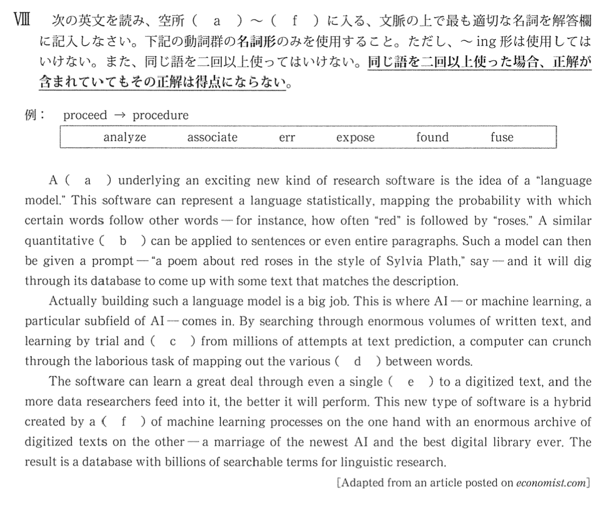 引用:2021年慶應商学部入試