(14) 3
難問。
表現が難しい。有名熟語のget rid ofからの引っ掛けを狙っている。
get rid ofのgetが受動態ということに気づき、rid A of Bを引き出せるかどうかが鍵になる。とはいえ、4を選んでも意味的には仕方がないとは思われる。
選択肢が有名熟語で並んでいるときには、ただ知っている熟語を入れるだけでは対処できないので要注意。
(27)
2
全文からonly oneだったら、とあるが、その後に追加があるので一つの要素だけではないことがわかる.notの後ろに前文要素の省略 the only one cost involvedの否定。
(28)1
難問。
文章の主語と目的語で因果関係を作っているので、因果、話題を出すbring upとなる。
make forも同じような意味を持つことがあるが、通例会話文などのinformalな場面で用い、かつ好ましいことが後にくるためNG.
下記辞書からの引用。
Don’t be lazy. That won’t make for your success.
怠けないことだな.怠けていては成功は無理だよ
『O-LEX』
(2) (くだけて)A<事・人>を生み出す, Aに寄与する, 役立つ(!通例好ましい事柄について用いる)
▶Love alone doesn’t make for a happy marriage.
愛だけでは幸せな結婚生活を営むことはできない.
『THE WISDOM』
⑵⦅略式⦆〈事〉に役立つ, …を生みだす
This makes for good human relations.
このことがよい人間関係を生みだす.
『GENIUS』
If something makes for another thing, it causes or helps to cause that thing to happen or exist. [INFORMAL]
▶ A happy parent makes for a happy child. [V P n]
『COBUILD』
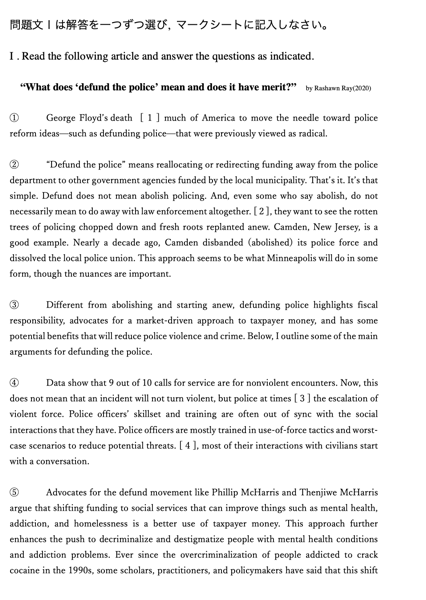
▷Does ‘defund the police’ have merits?
▷Should the US Implement a Universal Basic Income (UBI)?
▷Is Artificial Intelligence Good for Society?
▷Is Cancel Culture (or “Callout Culture”) Good for Society?
▷Should Humans Colonize Space?
▷Should Japanese Government Have Mandatory National Service?
▷Should Student Loan Debt Be Eliminated via Forgiveness or Bankruptcy?
▷Should BigTech be regulated?
▷Should coronavirus allow us to supervise our life ?
Western civilization’s foray into Asia brought about intricate changes in the tapestry of the continent. The 19th-century colonial pursuits introduced a spectrum of Western thought, technological advances, and cultural nuances. These colonial footprints led to the inception of European linguistic capacities and the adoption of governance structures reminiscent of Western paradigms. The debate surrounding these influences oscillates between the spectrum of modernization and the erosion of indigenous values. The confluence of Eastern and Western dynamics has fashioned a unique cultural mosaic, with the reverberations of this historical interaction continuing to influence the contemporary Asian landscape.
Firstly, it’s important to understand that when Western civilization ventured into Asia, it caused significant and complex changes across the entire continent. For instance, in the 19th century, as European countries pursued colonial ambitions, they brought with them a range of Western ideas, cutting-edge technologies, and distinct cultural practices. As a result of this colonization, many Asian regions began to learn European languages and even adopted governance systems that were similar to those in the West. Moreover, there has been an ongoing debate about these changes: on one hand, some believe they brought about modernization; on the other hand, there’s a perspective that it led to the fading of local traditions and values. Interestingly, as the East met the West, a special blend of cultures emerged. In fact, this blending of traditions and influences still plays a role in shaping modern-day Asia.










 を満たすすべての実数
 に対して
に対して となるか」を調べるのはパターン数も多くとても面倒である.そこで,「必要条件で可能性を絞って,虱潰しする」という方法を取ろう.この考え方はよく使う手段であるから,おさえておこう.具体的には,「
 かつ
かつ となる」を用いて,題意を満たす関数の組み合わせを絞っていく.「
 と分かる.後は,
 と,
と, の2つを虱潰しに調べればよい.


 となる確率((12)と(13)について)
 または,
または, であれば必要十分.
 ……(答)
……(答)![\int_{0}^{2}\left(-6x+15\right)dx=\left[-3x^2+15x\right]_0^2=18,\int_{0}^{2}\left(-3x^2+12\right)dx=\left[-x^3+12x\right]_0^2=16](https://hiroacademia.jpn.com/wp/wp-content/ql-cache/quicklatex.com-c3bfa33edb30774157f6fafbfffed269_l3.png "Rendered by QuickLaTeX.com")
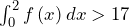 となるのは,
 .
. ……(答)
……(答)

 かつ
かつ となるような,
 の組み合わせは,
 の2通り.
の2通り. ……(答)
……(答) ……(答)
……(答) を考える.
を考える. で満たす必要がある(つまり,
 であるから,
 であり,
であり, は
は で
で となってしまうから,
 ……(答)
……(答) に揃える作業を行う.また,次々と新しい点を定義されていくため,次第にこんがらがってくるが,全て点
 を元に定義されているため,困ったら
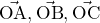 まで戻せば良い.
 の中点
の中点 」という情報と「
 と
と が平行になる」という情報を数式的にどのように表せるかを考える.「線分
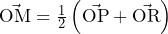 」と直し,「
 を用いて
を用いて と書ける」と直す.
 が底面に対してどのぐらい傾いているかで様子が違うことは直観できるだろう.ここで,前問(2)の結果を用いれば,点
 は
は を
を に内分する点であり,点
 に比べると大分点
 と辺
と辺 と共有点を持つと直観できる.すると求める面積は五角形の面積であるから,三角形3つに分けて面積を求めていけば良いという方針が立つ.体積の方も,図形が中々に複雑であるが,切り口の面積を求めさせていることから,ここを底面を見て考えるのが良さそうだと考えると方針が立つ.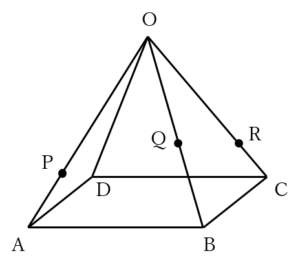


 より,
より, であるから,
 ……(答)
……(答) ……(答)
……(答)


 と書ける.係数比較をすると,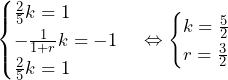
 ……(答)
……(答) であるから,
 とおく.
とおく.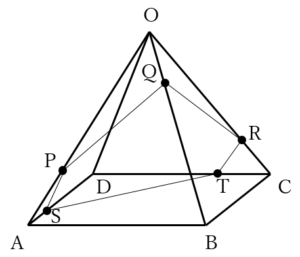
 であり,その面積は
 と
と と
と の面積の和に等しい.
 は平面
は平面 を用いて,
を用いて,
 を用いて
を用いて
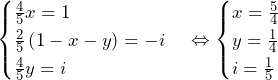

 も平面
も平面

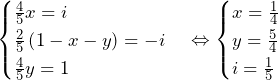


 より,
より, であるから,
 より,
より, であるから,
 より,
より, であるから,
 ……(答)
……(答) からなる多面体である.その体積は五角錐
 の体積と三角錐
 の体積の和と等しい.
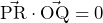 かつ
かつ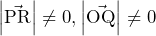 より,
より, .また,
.また, .よって,
.よって, は平面
は平面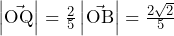 である.
である.
 より
より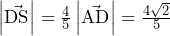 ,
, より
より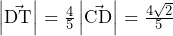 であるから,
 の面積は,
の面積は, である.
である. へ下ろした垂線の長さは1であるから,三角錐
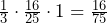 となる.
となる.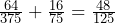 ……(答)
……(答)